You can trust VideoGamer. Our team of gaming experts spend hours testing and reviewing the latest games, to ensure you're reading the most comprehensive guide possible. Rest assured, all imagery and advice is unique and original. Check out how we test and review games here
As I sat and watched the world’s first Homefront: The Revolution footage, it wasn’t the graphics – which were, this being a Crytek joint, formidable in their own, post apocalyptic way – that struck me, nor the rather ordinary combat and crafting mechanics. Instead, I found myself considering that this sequel was another member of a burgeoning FPS sub-genre where America – home of the brave, land of the free, parking only 5 bucks – has somehow been taken over. As ever, only you, John Everyman, having seen your home and your livelihood wiped away, can take it back.
For a game which decries the propaganda of the invading Koreans, if I didn’t know better I’d say it was fairly propagandist itself. When a Crytek UK spokesman took to the stage and announced that the Greater Korean Army which was keeping its captured citizens in check had “watchtowers, drones”, I desperately wanted to ask him if he had read anything about America in the last 5 years. It’s also set in Philadelphia, the “home of independance”. Sheesh. I’m surprised a bald eagle didn’t swoop down onto the rep’s shoulder and squawk out the national anthem. Give it a rest.
That nonsense aside, Homefront: The Revolution (sadly not ‘Homefronter’, as Die Hard 2 and Friend of VideoGamer Ian Dransfield would have wanted) looks at least somewhat more interesting than the game that spawned it. Set four years after the original’s admittedly-enjoyable finale – where the rebels retook the strategic and symbolic Golden Gate bridge – not a lot seems to have changed. America is still under the jackboot of Korean oppression, its streets rammed with checkpoints and routine beatings, like a futuristic Cold War Berlin without all the interesting music. The game maintains the same aesthetic of its predecessor, only with a more technologically advanced bent. In places, it looks like a Killzone spin off.
The demo (hands-off, sadly) showed us the focus on guerilla fighting, Homefronter’s core concept. As ever, Crytek has excelled technically: looking over a refugee camp, it’s possible to pick out individual tents from their rows, their tarps billowing in the wind, bathed in harsh watchtower spotlight. (The general look may be muddy browns and combat greens, but the dynamic lighting as a whole was impressive.)
Texture work is excellent, even at this early stage, and draw distance and general visual fidelity is of the standard you would expect from the studio. It certainly helps create a feeling of being in the world, even if that world seems fairly dull. It’s your standard dystopian fare: this might be set in America, but it could be anywhere, at least from the early showing.
/https://oimg.videogamer.com/images/d095/homefront_the_revolution111111.jpg)
As uneventful was the moment-to-moment gameplay. Hacking plays a role, with the player being able to use a contraband phone to overrule enemy controls, remote pilot RC cars (more on that later) and tag enemies in the world. All very functional, all very obvious. During the demo, the player character had to use stealth to sneak in and out of buildings, picking up weapons and ammo from rebel safehouses before proceeding to a checkpoint to strike a blow for ‘Merica.
Once there, the crafting mechanic was shown off, with Captain America strapping a camera and a bomb to a RC car. Sneaking it in under cover of a moving supply truck, the subsequent detonation causes all hell to break loose. Out goes the sneaking, in comes the automatic gunfire. Again, from here on it’s par for the course: despite being told that the player characters are normal people and not trained soldiers, they sure do fight like them – the very first thing you do when you pick up your assault rifle is look at it, in true Crysis style, to see which attachments you can bolt onto it. Lots of manshooting ensues, followed by a quick, linear escape/chase sequence before the conclusion of the demo.
So, it’s a Crytek game: technically astounding, not actually all that interesting. Well, that’s the case with what was on show, at least. What’s most intriguing about Homefronter is what we didn’t see. Four-player co-op has been promised, as well as an open-world. How ‘open’ it will be will have to wait, but those two elements could combine to form something far more appealing than the sum of its parts.
In a dream world, we’ll get a multiplayer spiritual sequel to IO Interactive’s excellent Freedom Fighters: picking targets, choosing strategies, before squadding up and heading out. Recruiting rebels is on the cards, as is safehouse and base acquisition, which bodes well for an experience that’s not all dakka dakka dakka.
I hope that The Revolution reaches somewhere near the heights of IO’s PS2 classic, because it’d be a shame for Crytek to squander yet another good opportunity. It’s setting and premise may be utterly nonsensical, but there’s potential for a good game in there. Whether Crytek UK can pull it out of the bag is another matter entirely, especially as it seems the co-op and the campaign might be separate entities. We’ll see more at E3.
About the Author

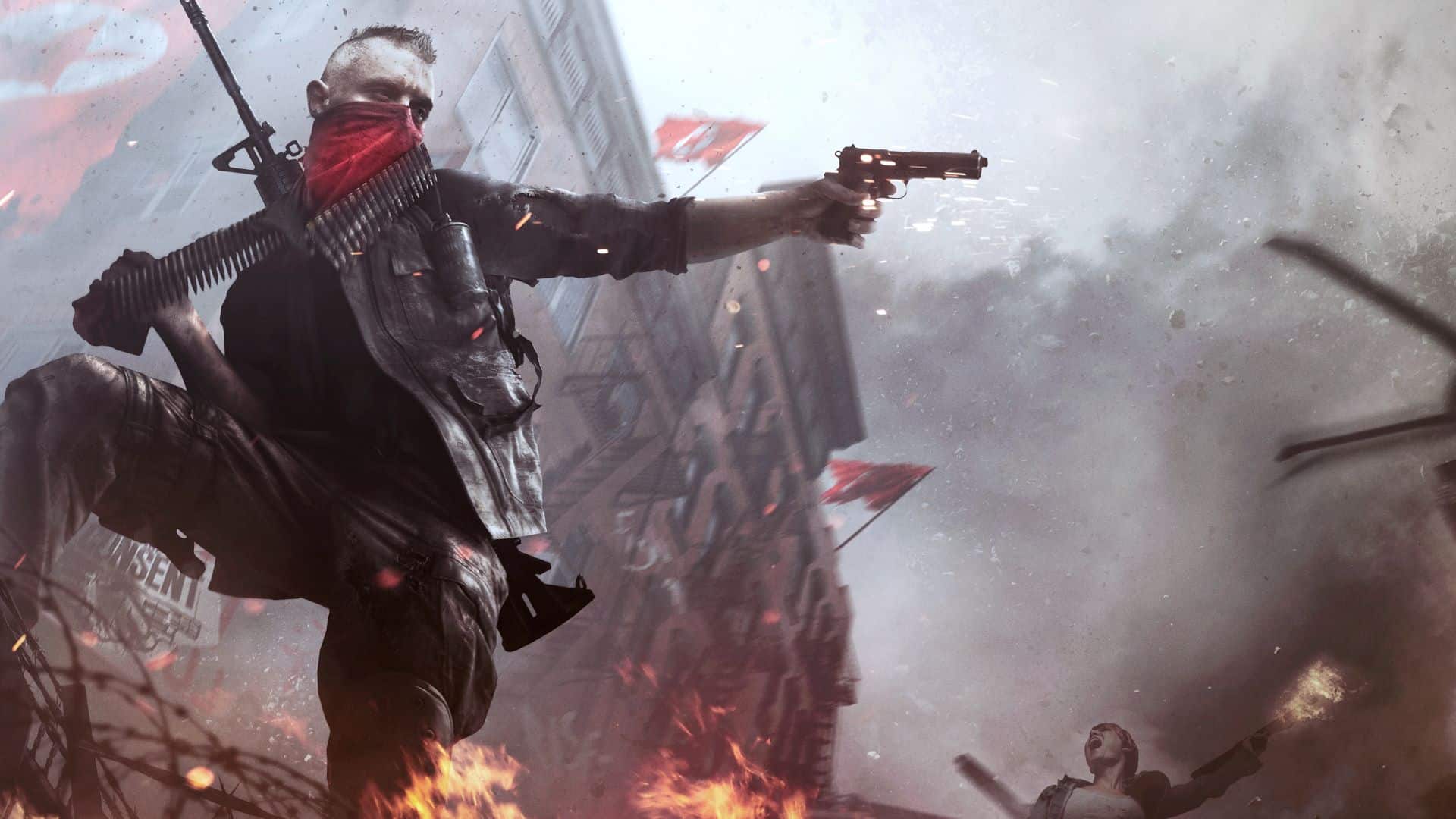
Homefront: The Revolution
-
UnknownUnknown
- Platform(s): PC, PlayStation 4, Xbox One
- Genre(s): Action, Adventure, First Person, Shooter