You can trust VideoGamer. Our team of gaming experts spend hours testing and reviewing the latest games, to ensure you're reading the most comprehensive guide possible. Rest assured, all imagery and advice is unique and original. Check out how we test and review games here
What do UFOs and UFO videogames have in common? They keep crashing! Ah-hah! Ha! Oh… Now that I’ve gotten that cheap gag safely out of the way, I can tell you all about ALTAR Interactive’s latest offering, UFO: Aftershock. Set nearly 50 years after its predecessor, UFO: Aftermath, Aftershock is not officially part of the Gollop Brothers’ UFO/X-Com franchise, but it does draw its influences heavily from the series.
The good news for anyone vaguely disappointed by Aftermath (as I was) is that Aftershock provides major improvements over the original. Even though the build we got to play had a number of bugs, it’s immediately obvious that all the criticism of Aftermath has been listened to and addressed.
Firstly, there’s a much better sense of narrative and an improved overall feeling of coherence to the game world, as the background to the game is fully explained by your advisors before the game starts in earnest. The Reticulan’s biomass experiment to create a planetary-scale biological computer has failed, and Earth has been left disparate, with society fragmented. It’s up to you and the descendents from the Council of Earth who took refuge on an orbiting ‘Laputa’ (an alien space station) to reclaim the Earth for humanity. This more detailed exposition of the background to the game not only makes what you’re meant to be doing clearer, but also makes you care about it a whole lot more. No more randomly fighting aliens for the sake of it – Aftershock provides you with a clear sense of drive and purpose. Missions are introduced by characters explaining the situation to you, rather than just by generic text. Likewise, research advances are related to you by your chief scientist, which makes things much easier to take in.
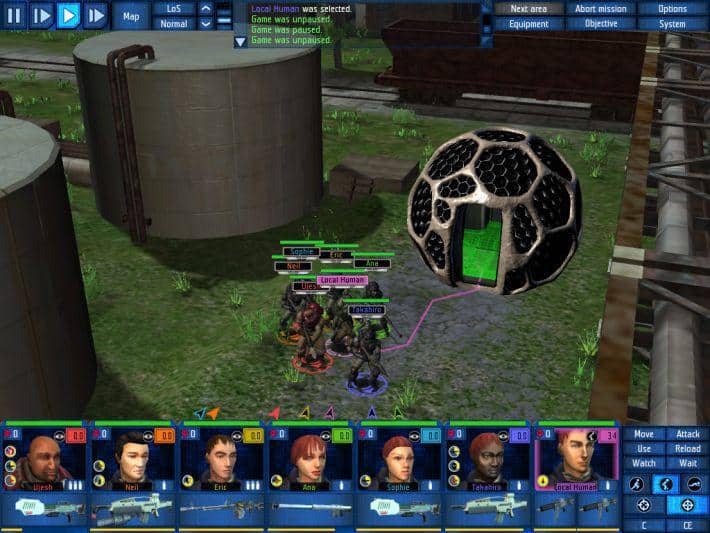
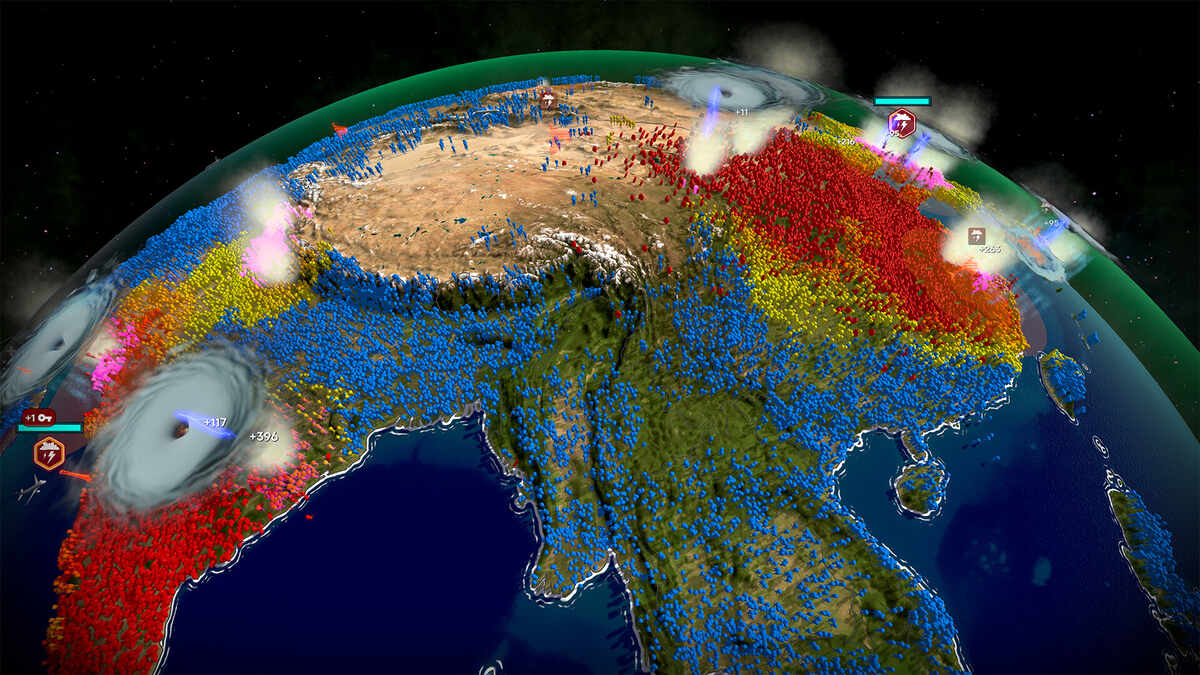
Graphically, the game is a quantum leap ahead of its prequel. The Geosphere campaign management screen is much prettier than Aftermath’s, and is even somewhat reminiscent of the main menu in Freespace 2, with scientists and other advisors often seen walking in the background of the room, adding just a few extra millibars of atmosphere to the game setting. The game interface is much less esoteric this time around, and you’re rarely more than a couple of clicks away from anywhere you want to go in the game. The 3D engine used to power the tactical engagements is also greatly improved with a much higher polycount, finer textures and lighting effects.
Combat uses the same ‘Simultaneous Action System’ as Aftermath, which is an unusual cross between real-time and turn-based combat. You can stack up orders for your soldiers, who will carry them out in real-time. Once any particular soldier reaches the end of their order queue (or ‘plan’, as the game calls it), the game auto-pauses to allow you to assess their situation and give them something else to do. So, unlike a true turn-based game, where one side uses up their action points, followed by the other, Aftershock has both antagonists and defenders acting simultaneously, but with the action stopping as your soldiers complete their assigned tasks. It takes a little getting used to, but is a very efficient form of micro-management and works a lot better than you might think.
It needs to, however, because your soldiers have absolutely no AI to speak of, or at least I’ve seen no evidence of any. Your hapless infantrymen will quite happily stand around being lasered to death by Reticulan Greys unless you specifically tell them to retreat or return fire. Fortunately, you can set the game up to autopause whenever one of your men spots an alien or becomes injured, so it’s only player stupidity that will result in these kinds of needless fatalities. The value of intensive micro-management of your squad and the benefits of not splitting up your fire team too much become especially apparent at higher difficulties. The accuracy and hostility of the alien forces at the two highest skill levels will ruthlessly and efficiently pick off any straggling soldiers you’ve been foolish enough to leave isolated. Don’t say you weren’t warned: Aftershock will provide a significant challenge to even the most experienced RTS and TBS gamers.
Happily, Aftershock has also reintroduced several elements from the original UFO: Enemy Unknown, plus one of the more successful gameplay mechanics from X-Com: Apocalypse. Base Management and economic management make a triumphant return, with a few interesting tweaks. Bases can’t just be plonked willy-nilly around the Earth’s surface where you see fit. X-Com: Apocalypse’s political faction system has been slimmed down and implemented here. There are four factions which need to be dealt with. The first Humans are the most straightforward, being survivors of the alien’s biomass experiment from the first game, and will be the first faction you meet. The Cyborgs are a mechanically-enhanced tribe of warrior types, perfectly suited for use as cannon fodder in your struggle to reclaim the Earth. Psionics are a group of women that have developed fearsome mental powers and been ostracised from human society. All three of these factions are initially neutral, and must be won over (either by sending them resources or by performing missions in the regions they control) before you’ll be able to build bases in their territory. The higher your standing with a particular faction, the better the troops you’ll be able to recruit from them. The final faction, The Cultists, are very similar to The Cult of Sirius in X-Com: Apocalypse and are hostile to your cause. Whether you can turn them into allies or not will probably only become apparent through extended play of the final game – though I suspect not.

Best of all, however, is the reintroduction of one of the most cosmetic, yet most immersive, features from UFO: Enemy Unknown – the ability to rename your soldiers. This allows you to form attachments to soldiers that would otherwise be nameless, faceless and expendable. Instead, you’ll mourn the loss of your friends (“Oh my God, they killed Olly! You bastards!”) and snigger at the fate of a particularly hated middle-manager you’ve just deliberately sent into a Reticulan ambush…
Despite the rawness of the code build we played, Aftershock gleams with potential. UFO: Enemy Unknown may just have a true successor (and not just a spiritual one) after all; after eleven long years, it’s high time.
About the Author