You can trust VideoGamer. Our team of gaming experts spend hours testing and reviewing the latest games, to ensure you're reading the most comprehensive guide possible. Rest assured, all imagery and advice is unique and original. Check out how we test and review games here
Korea’s gaming industry is a monster. It has enough life to fuel both its multi-billion dollar business and an e-sports community that churns out professional video game players who become celebrities in their own right. The country is a hotbed for gaming cafes, which have swept across the nation with a Starbucks-like intensity. This is a nation hosting an industry that’s grown so big, and so socially-acceptable, that it makes the West seem like it’s stuck in a rural Stone Age.
But now there’s something going on in Seoul. Back in April, Korea introduced legislation that put a curfew on online games. Thanks to this new Cinderella Law, between midnight and 6am all users under the age of 16 are locked out of online titles.
The Cinderella Law is the brainchild policy of Korea’s Ministry of Culture, Sports, and Tourism, along with the Ministry of Gender Equality and Family (MGEF). The curfew is part of a government-led legislation built to curb video game addiction in the country.
Recently, gaming addiction in Korea has become a talking point du-jour, which has resulted in everything from the opening of the first ever Game Addiction Centre to truly bizarre claims from officials.
While describing addiction to games, the secretary general of Children Health National Solidarity called it: “impulsive, [reducing] ability for resolving social problems and eventually [causing] cerebral disease which drives to death.”
She added that games addiction also “reduces the number of sperm and it results less social resources in light of less pregnancy.”
/https://oimg.videogamer.com/images/41f5/hot_coffee.jpg)
The MGEF itself has already demanded the industry give approximately $354 million USD to the government to help the prevention of games addiction.
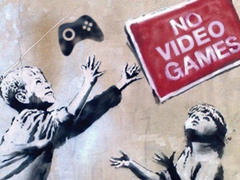
Why should we care about obscure Korean policy? Because, at its heart, the Cinderella Law is an extremist response to what’s effectively the same single issue that’s casting a hairy shadow over games culture on an international level: the moral panic over games corrupting the kids.
In the West we’ve seen these sentiments since the nascent period of mainstream video games, even before the hubbub surrounding the likes of Grand Theft Auto’s infamous ‘Hot Coffee‘ scene.
/https://oimg.videogamer.com/images/15dc/mortal_kombat_logo.jpg)
Ex-CEO of Acclaim Entertainment Greg Fischbach experienced it first hand in the early 90s, and was at the centre of what was one of the most crucial moments for the games industry.
Acclaim Entertainment was responsible for the console ports of the Mortal Kombat series, which by 1993 had become, as he puts it, “the disruptive factor in the gaming business”.
“Because it had blood in it,” he told VideoGamer.com. “Or it looked like it had blood in it.”
By the time it was released they had become old pros at courting controversy.
Mortal Kombat was one of the catalysts that would create the ESRB rating system in the States, after legal hearings held pointed to games like Mortal Kombat, Doom, and Night Trap as corrupting influences.
By the time the ratings system was put in place Adult-Only games were virtually impossible to even find in retail. In the States the primary games distributors were the likes of Walmart, Best Buy, K-Mart, and GameStop, and the more family-oriented retailers refused to carry adult-oriented titles full stop.
/https://oimg.videogamer.com/images/3533/mortal_kombat_3.jpg)
“Basically as a result of [Mortal Kombat], congress became very aggressive with us. And we formed ESA, which is now the ESRB, as a vehicle for controlling or appeasing… as a vehicle for dealing with the issues of the ratings. Because up until that point games weren’t rated,” said Fischbach.
The ESRB functioned as a self-regulating entity that would deflect any potential government regulation. Videotaped footage of the most extreme content of a game would be sent in to a group of trained raters who would work independently to recommend a rating, which is then based on the majority opinion. This kept violent titles from being banned outright.
Fischbach argues that the system Mortal Kombat unintentionally helped create was based on similar principles to the current film ratings system: awareness that cultural standards are relative.
“Like movies, what wasn’t acceptable yesterday is acceptable today. When Jack Valenti was running the Motion Picture Academy of America he would follow society trends and I think the gaming community will continue to follow society trends. So when they launched Mortal Kombat in 1993 it was ‘horrific’.”
Comparatively, Fischbach says in ’93 “60 minutes wanted to do an interview with the company, they wanted to position us, they were standing at the door.
/https://oimg.videogamer.com/images/3ba8/elspa_traffic_light_ratings.jpg)
“It wasn’t the kind of press that we wanted but when you look at it today and say ‘that’s what they were talking about?’ it looks kind of silly. So that’s how we move forward.”
Now it’s a slightly different world, even beyond Mortal Kombat. Last June the California government overturned the 2005 law that put games regulation in the hands of the government, on the basis of being unconstitutional.
However, just a few months ago that result was incredibly uncertain. Largely because the belief that legislation needs to be used as a barrier in the industry to protect minors from the effects of video games has been a dark cloud, a shadowy gorilla over the industry for decades.
Fischbach explains the crux of games regulation comes down to the difficulty of being able to define what video games are in the first place:
“Gaming was introduced in the United States as a toy. And there was a great deal of confusion as to whether it was a toy or whether it was entertainment in the late 70s, early 80s. And when people speak about it they speak about it as a toy.”
The Cinderella Law itself is being challenged by 14 games publishers. They include the likes of NCsoft, Neowiz Games, Com2us, Gamevil, and Nexon, and are working alongside the Korean Association of Game Industry to file the lawsuit by August.
But the vital intuition that resided in the gut of commentators in ’93 who pointed a finger at the industry for penetrating the moral cocoons of America’s youth, and those Californians who established the 2005 law for games to be government regulated, is the same that exists in the Korean ministry’s policy makers. Despite Korea’s status as a place that has cultivated a booming gaming community, it’s in as uncertain a position as any.
About the Author