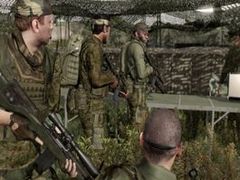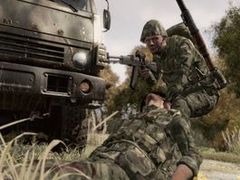
Life in camp wasn't the same since the Russians stole the TV...
Life in camp wasn't the same since the Russians stole the TV...Life in camp wasn't the same since the Russians stole the TV...

Here I am again, bleeding to death in the dirt. I try to stand, but my legs immediately give way and send me crashing back to the ground. "Help me!" I cry, in an unpleasantly distressed voice. "Somebody f*cking help me!" It's no use though - the rest of my team are either dead or busy fighting for their own lives. Should I wait to see if anyone comes for me, or simply reload from the last checkpoint? The game makes the decision for me: another spray of bullets rips through the air, smacking into my head. I never even see the man who kills me.

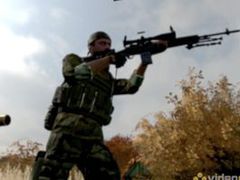
Though I've said it several times before, I'll say it again: ArmA II is an extremely harsh experience. If you run about like a ham-fisted Rambo, or try to play the game like Doom, you'll soon find yourself staring at the sky with a 7.62mm skylight installed in the top of your head. Even if you're a veteran of the first ArmA or of Bohemia's original military sim, Operation Flashpoint, you’ll still find it vital to stick by your team. There are no massive health bars or bonuses for the player character; the opposing forces can kill you just as quickly as you can kill them. In my most recent play test I spent much of my time following my squad mates – hitting the dirt when they did, listening to their observations, and generally trying to follow their lead. Yes, it was a bit cowardly – but it kept me alive. For a while.

 Advertisement

Of course, this punishing attention to realism – and the gripping tension that comes with it – has always been a part of the OpFlash/ArmA experience. What is now clear to me, after seeing the game for the first time since late last year, is that ArmA II will go further than ever before in terms of giving you full control over a military operation. When I visited Bohemia Interactive Studios in Prague last year I got to try out the game’s Warfare mode – a multiplayer mode that allows each participant to order in their own troops, construct buildings, and generally act like their own commander (although in fact there’s only one player who acts as the overall general for each side). The developers have now revealed that this base-building will be an integral part of the single-player campaign – an area which is now arguably the key focus of ArmA II.

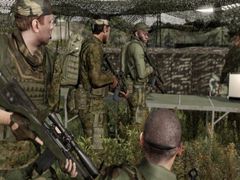
If you remember, the game’s plot deals with the political problems of Chernarus – a fictional Soviet country in the middle of a bloody civil war. A democratic party has just won the island’s national elections, much to the irritation of the Chedaki – the local Communist nationalists. In a nutshell, the whole scenario devolves into a hotpot of conflict between several rival factions: The Chernarussian army, the commie insurgents, a separate group of guerrillas, the Russian armed forces and finally the good ol’ United States Marine Core. In the campaign, you’ll take control of Razor Team – a five-man recon outfit who form part of the US presence in the area. Initially you’ll just be following orders from your commanding officers, but later on things will get a bit more complicated – leaving you to decide exactly how you’re involved with the battle for Chernarus.

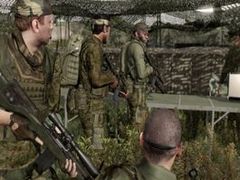
Moments later, Sgt Cooper received a particularly nasty splinter.Moments later, Sgt Cooper received a particularly nasty splinter.

From what I can tell, it seems as if Razor Team ends up being something of an independent force. After an initial set of missions that introduce you to the controls and the many ways of doing things, you’ll eventually lose contact with the rest of the USMC and have to look out for yourselves. Even in its early stages, the game will offer a huge degree of openness: your mission briefings will essentially form a list of things to do in one part of Chernarus’ massive 225 km square map, but it’ll be up to you to decide how you sort these tasks. At first you’ll be given fairly decent information as to what’s going on, but as time moves on you’ll eventually have to secure your own intel via recon missions and by interrogating local civilians (assuming you’ve not pissed them off by killing innocents).

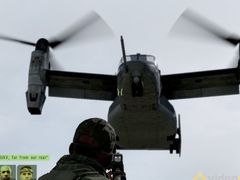
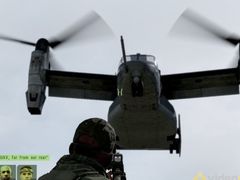
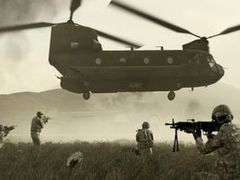
This probably sounds a bit intimidating, but BIS promises that the main campaign will gently guide you through everything, so by the time you take full command you should be at the top of your game. Like the original OpFlash, ArmA II starts you out as someone who merely follows orders, so there will be plenty of time to get to grips with things (especially the terrifying nature of one-hit kill infantry combat). When you do finally reach the top of the command chain, you’ll find a dizzying array of things to do and manage. There are towns to capture, supply lines to protect and new toys at your disposal. ArmA veterans will be particularly delighted by the inclusion of HALO drops – allowing you to parachute troops deep into enemy territory. And of course there are the 136 different vehicles (and variants) to mess around with – tanks, humvees, vertical take-off jets. If it’s good at blowing people up, it’s probably in this game.